

The Crowded Bond Bet Moved Into the Part of the Market Your Bond Fund Owns
For weeks the tension in Treasuries sat at the edges of the maturity range, in the 2-Year and the 10-Year. This week it moved to the middle. Dealers in the 5-Year Treasury dropped two full tiers to the bottom of their two-year range (z=-2.10), the only new extreme reading anywhere on the board, while the hedge fund crowd on the other side sits near the very top of its own range.
That matters more than it sounds for an ordinary portfolio. The five-to-ten-year stretch of maturities is the core of most broad bond funds, BND and AGG included, so this is not some trader’s corner of the market; it is the middle of the bond sleeve in a typical 60/40 or target-date account. Both big groups are still short the contract outright, so the story is where each one sits against its own history, not a bet on which way yields go.
This is Tuesday’s picture, and the days since have been rough for bonds. Treasuries sold off as markets began pricing in another Fed rate hike in October, with the damage steepest at the longest maturities, the dollar at an eight-week high and the S&P 500 and Nasdaq each off about half a percent. None of that shows anyone changing their position; PCE (the Fed’s preferred inflation measure) was on today’s calendar, and next week’s report is the first that can show how the pros handled the selloff.
This Week’s Positioning
The 5-Year Treasury: the pressure concentrated instead of fading
Last week the dealer extremes sat in the 2-Year and the 10-Year; both eased a notch this week while the 5-Year took their place. The hedge fund crowd is simultaneously near the top of its range in the 2-Year, the 5-Year and the 30-Year, and in the 5-Year and 30-Year it is still actively adding. That is a lot of like-minded money parked across the maturities a core bond fund holds, which describes a fragile arrangement, not a direction.
Watch: the September jobs report on October 2 (the monthly payrolls count, the next big number for interest rates). It lands squarely on these books, and on BND or AGG in your account.
The 10-Year Treasury: dealers let go of the floor, and did it in a hurry
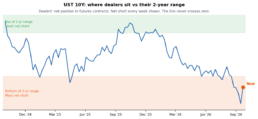
Dealers climbed off the bottom of their range to a reading that is still stretched but no longer extreme (z=-1.79), and the size of that shift was far outside what the week after a quarterly options expiration normally produces. Small traders, the group your own account belongs to, went the other way: they are leaning harder short on the 10-Year than at almost any point in the past two years. A small-trader crowd that lopsided has often been where the crowd gets it wrong, though that is a habit worth watching, not a forecast.
Watch: next week’s report, built from the September 29 snapshot. It is the first to capture the post-Tuesday bond selloff, and it will show whether dealers slid back toward the floor or held their distance.
Large-cap stocks: dealers covered, and the book landed near balance
S&P 500 dealers covered enough to move from neutral into a mildly above-average reading (z=+0.82), though they are still short outright, just less short than usual, while Nasdaq dealers slid back to the middle of their range. The hedge fund crowd stepped back to neutral in both, so the tug-of-war that had been building in tech unwound before it stretched. For an SPY or QQQ holder, the positioning under your core stock funds is unremarkable this week.
Watch: whether the S&P 500 holds the 7,800 area through the jobs report, after giving back about half a percent since Tuesday.
The Swiss franc: the fast money and the dealers squared off
Dealers stepped up into the stretched part of their range with a genuine long on the franc, while the hedge fund crowd is short it from near the bottom of its own range (z=-1.74), so the two now sit in opposite corners. Put plainly, the speculative money is betting the franc weakens against the dollar, and small traders are leaning the same way. For a regular investor this shows up through the dollar, which firmed since Tuesday and tends to weigh on unhedged international funds.
Watch: the franc near $1.22, where it sits after slipping almost one percent since Tuesday.
Elsewhere, the rest of the board is background. Short-term rate futures remain the one contract where both professional groups are stretched in opposite directions, though dealers trimmed a large slice there this week; small caps still carry the most one-sided speculative short among the stock indexes and were the weakest index since Tuesday, down almost two percent; institutions remain unusually heavy sellers of volatility protection with the fear gauge near 14.8; the Japanese yen and Australian dollar dealer books drifted back to neutral after big weekly swings; the euro and British pound dealer books shuffled without landing anywhere new, though the pound’s speculative crowd edged into the stretched low end of its range; Bitcoin’s speculative crowd eased back a tier while the dealer long stays thin; copper’s physical hedgers and speculative crowd are back at opposite ends of their ranges; gold, silver and crude show nothing at a genuine extreme; and in natural gas only the swap dealer book sits at the top of its range, where it also sat last week.
Know Where You Stand
- Look up the duration figure on your core bond fund this weekend. Duration is on every fund’s fact sheet and roughly tells you how much the fund moves when rates move; broad funds like BND and AGG sit around six years, right in the stretch of maturities where the professional books are most crowded, while a short fund like SHY sits near two and a long fund like TLT well past fifteen.
- Stocks and bonds fell together this week, so look at how your balanced mix actually behaved. If you hold a 60/40 or target-date fund, pull up the change since Tuesday on the stock and bond sides separately (SPY and BND are fine stand-ins); knowing that your bonds can drop alongside your stocks when rates are the story is the useful part, and it is not by itself a reason to rebalance.
- If you own copper or a mining fund, know that the speculative crowd there is packed near the top of its range. Managed money in copper sits near the top of its two-year range against physical hedgers near the bottom of theirs, which describes who owns the trade rather than where the price goes; if CPER or a miner fund like COPX has grown into a meaningful slice of your account, size it on purpose.
Data: CFTC COT Report 2026-09-22 | Prices as of 2026-09-25 | 104-week lookback