

The Bond Market’s Crowded Corner Moved to the 5-Year
As of Tuesday, Treasury positioning had found a new pressure point. Last week the 10-Year was the one maturity still pinned at an extreme; this week its dealers eased back a tier while dealers in the 5-Year Treasury added to their short at an unusually fast clip, landing near the bottom of their two-year range.
That matters if you own a core bond fund. The 5-Year sits in the middle of what BND or a short-to-intermediate Treasury fund like IEI holds, and the next two scheduled tests arrive back to back: the Fed’s rate decision (the FOMC meeting, October 28) and PCE (the Fed’s preferred inflation measure, October 29). It is also less of a two-sided fight than it sounds: the hedge fund crowd is short the 5-Year as well, so the other side of the dealer book belongs to asset managers, the pension and fund money that sits behind most retirement accounts.
This is Tuesday’s picture. Since then CPI (the consumer price index, the monthly inflation report) came out on Wednesday and stocks slid as headlines pointed to worries about the AI trade and higher oil prices; the Nasdaq fell about 4.6% while the S&P 500 lost about 2%. Treasuries rallied the other way, led by the 30-Year, which means yields fell; none of it shows how dealers handled the week, and next week’s report is the first that can.
This Week’s Positioning
The 5-Year Treasury: the stretch moved to the middle maturities
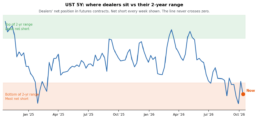
Dealers in the 5-Year went from a moderate short into stretched territory (z=-1.86) on a build far heavier than an options-expiration week typically brings. The 10-Year and 2-Year dealers both covered a tier at the same time, so the crowding concentrated in one maturity rather than spreading across the curve. Dealers’ options book in the 5-Year leans the opposite way, which fits hedging or arbitrage trades better than a straight bet on rates.
Watch: the Fed decision on October 28 and PCE the next day, the first scheduled numbers to land on the 5-Year’s new stretch.
The euro: the hedge fund bet against it reached a two-year extreme
The hedge fund crowd pressed its short in the euro to the very bottom of its two-year range (z=-2.15), while dealers are net short the euro too, so the two are on the same side and the big asset managers hold the long. With asset managers also long the dollar index, this is one story rather than two: the speculative money leans toward a firmer dollar, which is the setting that weighs on unhedged international funds. Since Tuesday the euro has actually edged up about half a percent and the dollar index slipped to about 101.8.
Watch: the euro between $1.13 and $1.14, the zone where the hedge fund crowd built its short and right where it trades now.
The Australian dollar: dealers stepped off neutral
Dealers moved from neutral into a moderate long on the Australian dollar, on a build unusually large for an options-expiration week. The hedge fund crowd is long as well, which leaves the big asset managers holding the short, and theirs is the deepest in their two-year range; in currencies that arrangement often reflects hedging rather than a view on direction. The Aussie has slipped about 0.7% against the dollar since Tuesday.
Watch: whether the Australian dollar gets back above 70 cents, the bottom of the zone where the hedge fund crowd built its long; it ended the week just under it, which matters if you hold an Australia fund like EWA.
Elsewhere: Bitcoin’s dealer long, which is structural, slid to the lowest reading in its two-year range, still a long and not a bet against it, with Bitcoin down about 2% since Tuesday to around $81,300. Dealers in the British pound hold a genuine long just shy of extreme, though their options book no longer backs it up, and SOFR futures (the market’s bet on short-term interest rates) kept their dealer stretch for another week. Mexican peso dealers extended a four-week build and the Swiss franc’s hedge fund short deepened without changing tier. The 30-Year’s hedge fund crowd held its extreme on paper, still short outright, and small-trader positioning in the 2-Year sits at the low end of its two-year range. In stocks the picture stays mild: S&P 500 dealers remain less short than usual, Nasdaq dealers added shorts for a second week and the Russell 2000 hedge fund short eased a tier, while institutions remain heavy sellers of volatility protection in the VIX market. In commodities, crude oil’s hedgers added heavily as oil climbed about 5% since Tuesday to near $99, natural gas hedgers drifted back to the middle of their range and gold, silver and copper were quiet.
Know Where You Stand
- Any hedge you add now costs more than it did on Tuesday, so price it at today’s level. On Tuesday institutions held a historically stretched bet against volatility with the VIX near 15; it has since climbed to about 20, so protecting an SPY or QQQ position is noticeably dearer, which describes cost, not where the market goes next.
- Check whether your bonds actually cushioned your stocks this week. Treasuries rallied while stocks fell after Tuesday, with long-dated funds like TLT moving the most, so pull up your own statement and see how much of the equity drop your BND, IEI or TLT holding offset.
- Put a dollar figure on what the Nasdaq’s slide did to your account. The Nasdaq fell more than twice as far as the S&P 500 since Tuesday, so if QQQ and the megacap names inside SPY make up a large share of your money, compare the actual loss to the drawdown you decided in advance you could live with.
Data: CFTC COT Report 2026-10-13 | Prices as of 2026-10-16 | 104-week lookback