

The Bond Desks Dug In Six Days Before the Fed
The single most stretched position anywhere in this week’s report is in 10-Year Treasuries, where dealer desks pushed their short to the very bottom of its two-year range (z=-2.29) for a fourth straight week in the same direction. The big asset managers hold the other side of that trade near the top of their own range. Nobody is hedging this quietly; both sides keep adding.
For a normal portfolio that lands squarely on the bond sleeve. Intermediate and long-dated bond funds are where this book lives, and the professional money is arranged around the September 17 Federal Reserve rate decision rather than around anything that has already happened. August consumer inflation, released Wednesday, failed to cool, which is what turned a crowded rate position into a tense one.
Remember this is Tuesday’s snapshot and you are reading it on Friday. Since then the whole Treasury curve sold off with the longest maturities worst, small caps slid about two percent, the dollar firmed and crude oil pushed through $100. That is price action, not evidence that anyone moved their position; the next real look at positioning is next week’s report.
This Week’s Positioning
Copper: where commercial hedgers sit vs their 2-year range
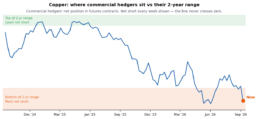
The producers and merchants who hedge physical copper stepped deeper into that hedge this week, down near the low end of their two-year range (z=-1.78), on one of the largest weekly shifts anywhere in the report. Managed Money, the speculative crowd, went the other way and now sits at the top of its own range, so the two groups are as far apart as this data gets. Copper trades around $6.55 after a strong run, and this arrangement describes who is holding what, nothing about where the price goes next.
Watch: whether copper holds above $6.50 through the Fed decision. Copper exposure shows up for most people inside a broad materials or commodity fund rather than through CPER directly.
Short-term rate futures: both sides pinned at the extremes
SOFR futures, the market’s bet on short-term interest rates, are the one contract where the dealers and the hedge fund crowd are both at historical extremes at the same time, in opposite corners. Read that as maximum tension into next week’s Fed meeting rather than as a view on rates, and discount it further: nearly two fifths of the speculative side is tied up in roll and calendar trades that carry no directional opinion at all.
Watch: the Fed statement on September 17. This is the book most directly exposed to a surprise in the language about the path of rates, and a regular investor feels it through short-dated bond funds like SHY and cash-like holdings.
The Japanese yen: the whole book got wiped clean
The yen saw the largest weekly repositioning of any market in the report, and it moved both professional groups at once: dealers crossed from a modest long into a net short yen position, while hedge funds abandoned a stretched short and went back to roughly flat. Both cohorts now lean the same way, mildly against the yen, which leaves this the least stale currency position on the board.
Watch: the dollar-yen rate into the Bank of Japan and Fed meetings. Japan is a top weight in almost every international index fund, so this one reaches a standard portfolio through the foreign sleeve.
Large-cap stocks: the two indexes stopped pulling apart
S&P 500 dealers moved up out of neutral into a mildly stretched posture on repositioning the tool flags as unusually large with no scheduled event behind it, while Nasdaq dealers came back down into neutral from the short side. The tech divergence that ran for several weeks has drained out of the futures book. The one exception is the Nasdaq options-implied reading, which is the most stretched figure on the board and sits far from where the futures say, so the tech story this week is an options-book fact rather than a positioning one.
Watch: how QQQ trades relative to SPY into the Fed decision. Small traders, the cohort your own account belongs to, are crowded near the high end of their range in Nasdaq, which is often where the crowd gets it wrong.
Everything else is holding a pose it has held for weeks. Small caps still carry the most one-sided speculative short in the report against an outright dealer long, unchanged from last week and now background rather than news. The dollar index stays pinned with dealers stretched short against a fast-money long, a consistently dollar-bullish lean that also shows up as a crowded short in the euro, and the Mexican peso holds the same maximum-tension setup. Institutional appetite for volatility protection faded again, with the big asset managers showing little interest in owning it while small traders sit near the top of their own range holding protection. In Bitcoin, the structural dealer long keeps sitting at the floor of its two-year range while the hedge fund crowd stays near the top of its own. The British pound, Swiss franc, Canadian dollar and Australian dollar all shuffled without reaching a stretch, and gold, silver, crude and natural gas show the usual hedger-versus-speculator gap with nothing at a genuine extreme.
Know Where You Stand
- Protection is unusually cheap right now, and that is a fact about pricing, not a recommendation to buy it. The fear gauge sits near 15.9 with institutions net short volatility, so if a hedge on an SPY position was ever part of your plan, this is the part of the cycle where it costs least; if hedging is not part of your plan, the useful version of this is simply knowing you are unhedged going into September 17.
- Your foreign holdings carry a dollar bet you did not choose. The professional money is leaning dollar-bullish through several currencies at once, and a stronger dollar quietly drags on unhedged international funds like VXUS and on commodity exposure; worth checking whether your foreign sleeve is currency-hedged, because most default options are not.
- Check whether tech has crept up as a share of your account. Small traders are crowded at the high end of their range in Nasdaq futures, and the same drift happens passively in retirement accounts when a few large names run; pull up your actual QQQ or total-market weighting rather than assuming last year’s allocation still holds.
Data: CFTC COT Report 2026-09-08 | Prices as of 2026-09-11 | 104-week lookback