

Bond Dealers Stepped Back From the Edge, Five Days Before the Inflation Report
The most crowded corner of the Treasury market emptied out faster than it filled. As of Tuesday, dealers in the 2-Year and 5-Year Treasury had pulled well away from the bottom of their two-year ranges; the 5-Year dropped two full tiers in a single week on the biggest rates move on the board, with no Fed meeting or options expiration nearby to explain it.
That matters if you own a bond fund, because the pressure is now concentrated in one maturity instead of spread across several. The 10-Year Treasury, the maturity behind intermediate funds like IEF and a big slice of BND, is the only one still at an extreme, and CPI (the consumer price index, the monthly inflation report) lands on it Wednesday, October 14.
This is Tuesday’s picture. Since then the 2-Year and 5-Year have barely moved in price while the 30-Year firmed, which means long-term yields eased a little. Stocks slipped, led lower by the Nasdaq, and none of it tells us how dealers handled the week; next week’s report is the first that can.
This Week’s Positioning
The 2-Year and 5-Year Treasury: dealers let go of the floor
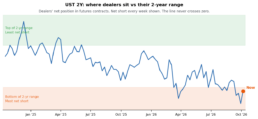
Dealers in the 2-Year climbed out of extreme territory into the stretched zone just above it (z=-1.60), and 5-Year dealers fell all the way back to a moderate short; both are still net short, just no longer pinned to the low end of their range. The 10-Year dealers covered too, but their short is still the deepest on the board, with the big asset managers holding the other side near the top of their own range. In the 2-Year and 5-Year the small-trader crowd has also pulled back to the low end of its usual long, so retail money has largely stepped away from short-term Treasuries rather than piling in.
Watch: CPI on October 14, the next major scheduled release aimed squarely at the 10-Year, the last maturity still sitting at an extreme.
Nasdaq: dealers leaned short out of nowhere
Nasdaq dealers added to their short in an unusually large one-week move, enough to push them from neutral into a moderate short. It is a mild reading rather than a crowded one, but it arrived with no calendar event behind it and it runs opposite to the S&P 500, where dealers are less short than usual. Since Tuesday the Nasdaq has been the weakest of the three major indexes, down a little over 1% as headlines focused on a stumble in the AI trade; that is price, not evidence that dealers did anything more.
Watch: the Nasdaq near 30,800, the top of the zone where the hedge fund crowd built its current position and about 1% below where the index sits now.
Bitcoin: the dealer cushion is the thinnest in two years
Dealers’ structural long in Bitcoin slid to the very bottom of its two-year range, into stretched territory (z=-1.58), though they are still net long. Past weeks like this saw Bitcoin higher a month later in 3 of 5 cases, close to its 57% base rate of rising in any four-week stretch, so the history says little either way. Since Tuesday Bitcoin has dropped about 3.6% to just under $83,000.
Watch: whether Bitcoin holds above $76,600, the bottom of the zone where dealers built their long; spot ETFs like IBIT track the same price.
The Mexican peso: dealers dropped their bet against it
Peso dealers covered on the largest weekly move anywhere on the board and flipped to a token net long, capping four straight weeks of building. The hedge fund crowd is long the peso too, so the bet against it now sits with the big asset managers, whose short is the deepest in their two-year range, a posture that in currencies often reflects hedging rather than a view. The peso has fallen nearly 3% against a firmer U.S. dollar since Tuesday, the biggest currency move of the week.
Watch: next week’s report, the first to show whether dealers kept their new long through the slide; it matters most if you hold an emerging-markets fund like VWO with Mexico exposure.
Elsewhere: the 30-Year Treasury’s hedge fund crowd reached the light end of its short range, an extreme on paper that still means short outright, while 30-Year dealers sit mid-range. Dealers in the British pound hold a genuine long just shy of extreme, and SOFR futures (the market’s bet on short-term interest rates) kept their opposed stretch for another week. The hedge fund short in the Russell 2000 eased back from extreme to stretched, institutions remain the heaviest sellers of volatility protection on the board with the VIX near 14.8, and euro and Australian dollar dealers covered heavily. In commodities, natural gas’s speculative crowd pressed its short into stretched territory while its hedgers carry a lighter hedge than usual; gold, silver, crude and copper are background.
Know Where You Stand
- Before CPI on October 14, find out which part of the Treasury market your bond fund actually owns. A short-term fund like SHY lives near the 2-Year, where the crowding just eased, while IEF and much of BND sit closer to the 10-Year, the one maturity still stretched to an extreme, so the same inflation print can land differently on each.
- Add up how much of your stock money is really one tech bet. SPY’s largest holdings are the same megacap names that drive QQQ, so if you own both, know your combined tech weight before the Fed’s rate decision (the FOMC meeting, October 28) and PCE (the Fed’s preferred inflation measure, October 29) land back to back.
- If you hold a spot Bitcoin ETF, size it for swings you have already seen. Bitcoin gave up about 3.6% between Tuesday and Friday; whether that holding is 1% or 10% of your account, decide now what move you could sit through, since nothing in this data says which way the next one goes.
Data: CFTC COT Report 2026-10-06 | Prices as of 2026-10-09 | 104-week lookback