

Nasdaq Positioning Tilted Before the Slide, and Bitcoin's Dealer Cushion Is Down to Its Thinnest
The biggest change on this week’s board is in the Nasdaq. Dealers, the market makers who take the other side of everyone else’s trades, stretched their short from a moderate reading to an elevated one on the heaviest weekly shift of any market tracked. At the same time, the hedge fund crowd flipped from a small short to a long, so the two groups ended Tuesday leaning in opposite directions in the same index.
That is Tuesday’s picture, and the week that followed looks different. Since then the Nasdaq has fallen about 4%, the S&P 500 about 2% and the VIX (the market’s fear gauge) has jumped from roughly 21 to above 24. Headlines point to an AI-driven tech sell-off, and the October jobs report landed today. None of that selling can show up in positioning until next week’s report, so read what follows as the setup going into the drop, not a response to it.
For someone who owns QQQ or a broad index fund heavy in tech, the practical point is that the Nasdaq entered this slide with the two big groups of professionals on opposite sides and with small traders also leaning the same way as the hedge funds. That describes how the market was arranged, not what happens next, and the wider market looked calmer: S&P 500 dealers moved back toward a neutral reading.
Bitcoin is the other new arrival at the edge. It is a separate story from stocks, and the data says so: positioning stress there is not spilling over from equities. Both dealers and hedge funds moved into the most extreme tier of their two-year ranges this week.
This Week's Positioning
Nasdaq: dealers stretched short, hedge funds crowded onto the other side
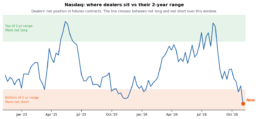
Nasdaq dealers are now short by more than at any point in the past two years (z=-1.81), a step up from last week’s moderate reading. Hedge funds are on the buy side with a fresh position near the top of their own range, and small traders are leaning hard that way too. The S&P 500 shows nothing like it: dealers there slid back to a neutral reading, so the strain is in tech, not across the whole market.
Watch: whether the Nasdaq keeps trading below roughly 28,500, the bottom of the zone where dealers built their short, a level that matters if you hold QQQ.
Bitcoin: the dealer cushion is the thinnest in two years
Dealers still hold a net long in bitcoin futures, but it has thinned to the bottom of its two-year range (z=-2.09), which leaves less inventory to absorb one-sided trading than usual. Hedge funds are net short but lighter than they normally run, a mirror-image extreme. Bitcoin has slipped about 2% since Tuesday to near $75,800, which is just under the dealers’ break-even zone of roughly $76,600 to $83,200.
Watch: whether bitcoin gets back above $76,600; that is a price level, not a signal about what dealers will do next.
Treasuries: the short end eased while the long end moved the other way
Two-year Treasury dealers covered a good part of their short and dropped from a stretched reading to a moderate one, while 30-Year dealers added shorts and moved from neutral to moderate. The 10-Year dealer short is still stretched, with big asset managers holding the matching long. Treasury prices have risen since Tuesday, meaning yields eased, though that is price action and not a read on what dealers did afterward.
Watch: CPI (the consumer price index, the main inflation gauge) on November 10, the next release for the bond and short-term rate books.
Elsewhere: The euro and natural gas stories are the same as last week: hedge funds in the euro and speculators in natural gas are still at the most lopsided short readings in two years, so they are background now. Gold and crude producers still hold stretched readings; since Tuesday gold is up about 3%, silver nearly 5% and crude down roughly 6%, which are price moves and not new positioning. Dealers in the Canadian dollar trimmed their long on heavy trading, and Swiss franc hedge funds are holding a stretched short. The VIX has jumped, but institutions were still net sellers of that protection on Tuesday. Russell 2000, copper, yen, pound, Australian dollar and Mexican peso are quiet.
Know Where You Stand
- Check how much of your account is really one tech bet. Many S&P 500 index funds are heavily weighted to the same large tech names that sit in QQQ, so owning both can be less diversified than it looks.
- Look at your stock-to-bond mix after this week’s slide. A drop like this pulls a portfolio away from its target; compare your current split to the one you chose before deciding whether anything needs adjusting, and note that November 10 is the next inflation report.
- If you hold a bitcoin fund, size it for a bad month. Ask whether a further 10% drop would change anything in your plans; if so, the position is worth reviewing, whatever the dealer data says. Bitcoin itself trades around the clock while funds such as IBIT or FBTC only trade during market hours, so a weekend move can show up in your account all at once on Monday, which is another reason to settle the size in advance.
Data: CFTC COT Report 2026-11-03 | Prices as of 2026-11-06 | 104-week lookback